Minecraft 26.4 server: snapshots, new settings and the ice caves
Minecraft 26.4 is the next Java version. Mojang announced the ice caves and a frozen zombie variant for the next game drop, without a date; that drop is expected to be 26.4 (the Minecraft Wiki lists Bedrock 26.70 and expects the fourth quarter of 2026). The first snapshot, 26.4 Snapshot 1 from 22 September, doesn't contain those ice caves yet, but it does add three new options to server.properties, a new datapack format, sulfur caves beneath old worlds and Vulkan as the default renderer in the client. Test on a separate server or a copy of your world; your main server waits for the release and, if you run Paper, until Paper and your plugins are ready.
Snapshot 1 is a technical snapshot, still without ice caves
Mojang itself describes this first snapshot as kicking things off with "a range of technical updates and improvements". The ice caves, the icicles, the ice crystals and the frozen zombie (no final name yet) were only announced at Minecraft LIVE on 26 September, four days after this snapshot. Mojang hasn't said which snapshot they'll appear in, and anything can still change before the release.
The most noticeable change is on the player's side: in the "Graphics API" video setting, "Default" now behaves like "Prefer Vulkan"; until now, that was OpenGL. Your server won't notice any of this. If the game crashes for a player right at startup, it no longer switches over by itself: that player then sets the option to "Prefer OpenGL" manually.
Three new lines in server.properties
Three keys are added, shown here with their default values:
allowed-connection-ids=
status-contact-details=
enable-legacy-status=true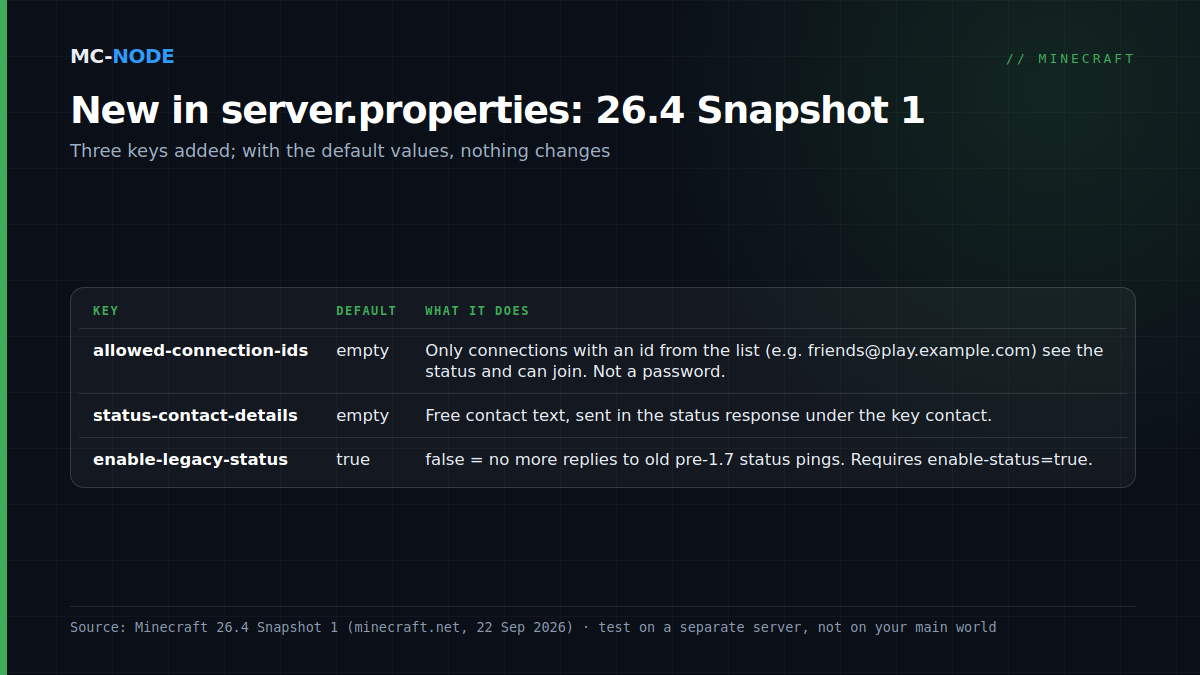
allowed-connection-ids: only players who send the right id get in
A comma-separated list of ids. If it's empty (the default), nothing changes. If you fill it in, the server compares those values with the _id the client sends along and rejects every connection without a matching id, both for the status request and at login: without the right id, there's no server status and no joining.
You put the id in the server address, and that's new in this snapshot too. The client reads an address like [email protected] as play.example.com?_id=friends. So with allowed-connection-ids=friends,team, only players who put one of those two ids in front of the address get in. A scanner that simply works its way through IP addresses doesn't know the id and gets no reply to the regular status request; whether that also applies to the old ping protocol, the changelog doesn't say.
It's explicitly not a password: according to Mojang, the connection packet is unencrypted, so it isn't suitable for anything security-sensitive. You still need your whitelist. And because the notation is new, only the snapshot client knows it for now.
status-contact-details: a contact line in your server status
Free text that shows how to reach the owners of a server, even without a website: an email address or a Discord invite, for example. The server sends it along in the status response, under the key contact. Whether and where the regular client shows that line isn't in the changelog; any program that requests the status response can read it, though.
enable-legacy-status: switching off the old ping protocol
Clients from before 1.7 requested the server status with an older protocol. With enable-legacy-status=false, your server stops answering those requests; by default, the option is set to true. For any kind of status, old or new, enable-status has to be on. Unless you have a reason, leave it on. The other lines are covered in server.properties explained.
Old worlds get sulfur caves beneath them when they're converted
Do you still have a world (or parts of one) from before 1.18 (Caves & Cliffs Part II) that hasn't been opened in a newer version since? When converting old chunks like that, Minecraft has been generating new terrain beneath them since 1.18, down to the new bottom at Y=-64. From 26.4 Snapshot 1 onwards, sulfur caves, the cave biome from 26.2, can appear there too; that's what the new biome tag #generated_in_below_zero_retrogen is for. Chunks that have already been converted or generated in 1.18 or later won't notice any of this.
Datapacks, commands and networking: what creators need to retest
- New pack formats. The datapack format goes to
122.0(26.3:121.0), the resource pack format to98.0(26.3:97.1). Test packs made for 26.3 (format 121) before you bump the format. - Custom worldgen. The
default_blockfield in the noise settings is gone (always air; you handle other blocks through the material rules). For thecuboidmodifier,xz_sizeandy_sizeare now the actual size: 2 gives 2×2, not 3×3. Placed features may now only place within an area of 3×3 chunks, and entries for different biomes in multi-noise sources may no longer overlap across all noise parameters with the same offset. - /fillbiome. Until now, the command worked per cell of 4×4×4 blocks, so the edge didn't always line up exactly with your coordinates. According to the changelog, it now fills biomes with block accuracy.
- NBT rounding. When converting decimal numbers to whole numbers, the game now always rounds down. Scripts using
/datacan therefore give a different result in edge cases. - Networking. The client sends a new
minecraft:mod_listpacket (empty on vanilla) to make debugging easier,minecraft:transfercan pass properties on to the target server, and with an SRV record, the original domain is sent along as_o.
How to test the snapshot safely
Mojang itself warns that testing versions can damage your world: make a backup and run them in a different folder from your main world. If you open a snapshot world in an older version again, the game warns that it may become corrupted: your way back to 26.3 is your backup.
- Make a backup of your main server and check that it's complete (how to make a backup). How to set this up properly is covered in a backup strategy that really works.
- Use a separate test server, or at least a copy of your world folder.
- Put the snapshot jar on it. Mojang offers a separate server.jar with every snapshot, linked in the snapshot post on minecraft.net. How to upload your own jar through the file manager is explained in uploading a custom server jar.
- Java 25. Like 26.1 through 26.3, the snapshot requires Java 25. If your server already runs 26.x, you don't need to switch anything; if you're coming from 1.21, first read which Java version your server needs.
- Clients on the same snapshot. Players enable snapshots in the Minecraft Launcher, on the "Installations" tab. The snapshot has a different protocol number from 26.3, so a 26.3 client can't join your test server, and vice versa.
- Test what you use: your datapacks, command blocks, the new settings and possibly an old world being converted for the first time.
Your main server waits for the release, and for Paper
A snapshot is a work in progress: more will follow before the release, and each one can change formats and behaviour again. During the snapshots and pre-releases, the 26.3 datapack format went from 108.0 to 121.0.
As of 27 September, Paper's downloads API lists no 26.4 (it does list pre-releases and release candidates, but no snapshots). Even 26.3 is still experimental on Paper: all builds are in the alpha channel (latest: build 49 from 26 September), and the latest stable Paper is 26.2 build 129. If you run Paper with plugins, only update once there's a stable build and your most important plugins list the new version. The status for 26.3 is in which plugins already work on 26.3.
When not to, and when to
Don't: put your main server or an SMP with a long world history on a snapshot, not even "just quickly" to see the ice caves, because they aren't in it yet. Worth it: if you manage datapacks, custom worldgen or a network with transfers and want to know what breaks before 26.4 is out. For a test server like that: at MC-Node, a Minecraft server starts at €0.50 per month, with backups in the game panel and monthly cancellation: you cancel it as soon as 26.4 is out and your main server has moved over.
Frequently asked questions
Are the ice caves already in Minecraft 26.4 Snapshot 1?
No. 26.4 Snapshot 1 from 22 September 2026 is a technical snapshot, with new server settings and Vulkan as the default renderer, among other things. The ice caves were announced on 26 September for the next game drop, which is expected to be 26.4, but Mojang hasn't said which snapshot they'll appear in.
When does Minecraft 26.4 come out?
Mojang hasn't given a date yet. 26.4 is the next Java version and is expected to be the next game drop, with the ice caves; the Minecraft Wiki lists Bedrock 26.70 and expects the fourth quarter of 2026. Until then, snapshots will come out and the content can still change.
Can I run a Minecraft snapshot on my server?
Yes, Mojang offers a separate server.jar with every snapshot; 26.4 Snapshot 1 runs on Java 25. Do it on a separate test server or a copy of your world, because testing versions can damage your world. Players pick the same snapshot in the launcher.
What does allowed-connection-ids do in server.properties?
With this new option from 26.4 Snapshot 1, the server only allows connections that send along an id from the list, for example via the address [email protected]. Anyone who doesn't include the id sees no server status and can't join. It isn't a security measure: the connection packet is unencrypted, so you still need your whitelist.